
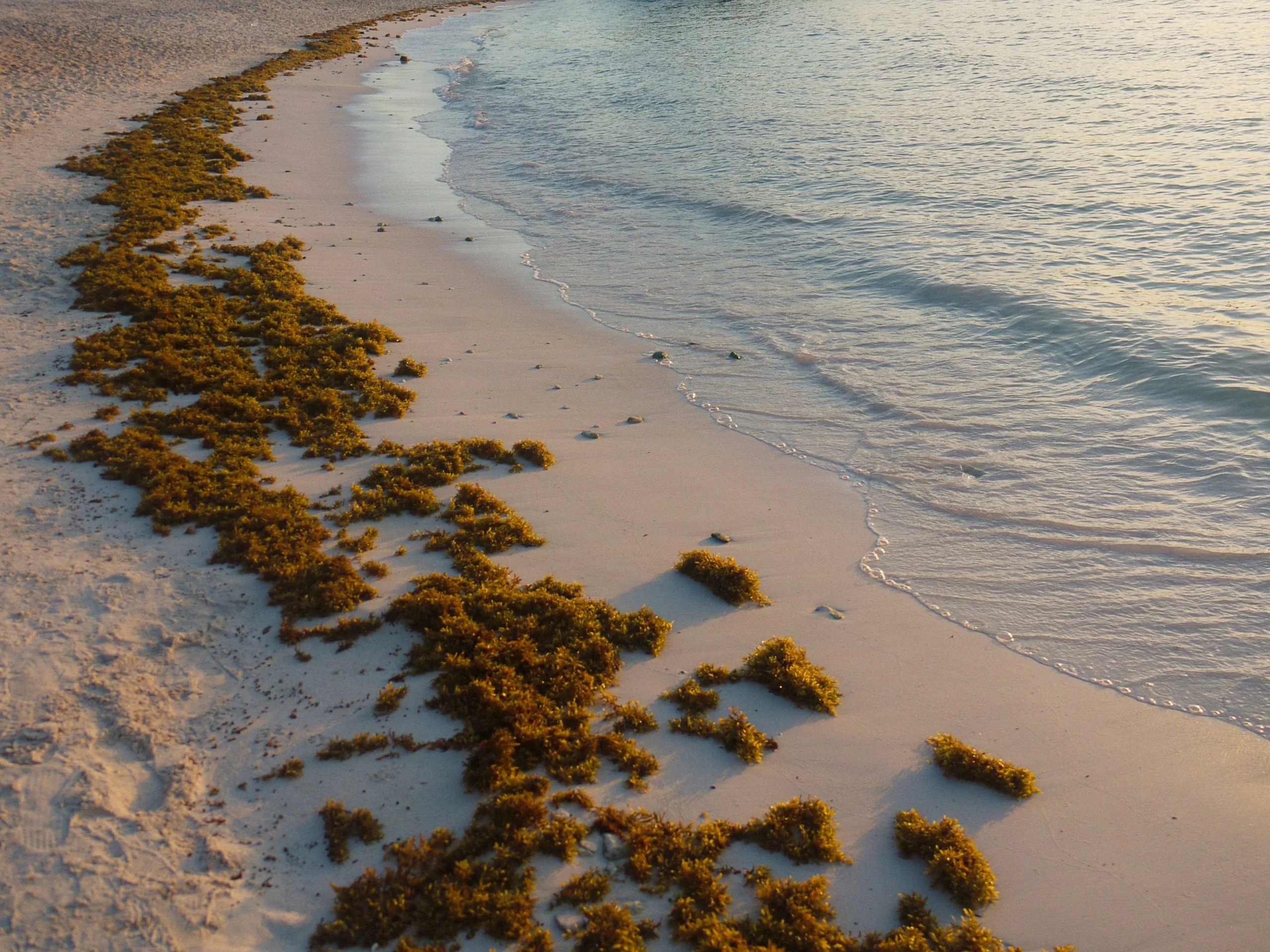
Seaweed on Wedding Week: How to Use the 8-Day Sargassum Forecast and Build a Plan B
You’ve pictured the aisle in the sand and the turquoise water behind you. Now picture checking your phone the week before and seeing a brown line of seaweed along the shore. What would you do?
It’s a scary thought. It’s also manageable if you plan for it. Here’s how to read the forecasts that exist, what they can’t tell you, and how to build a Plan B before you leave home.
<h2>What the 8-day forecast is</h2>
One tool people mention for this is the Sargassum Early Advisory System, or SEAS. According to one Cancun travel guide, <cite>SEAS began in 2013 to forecast large sargassum landings in Texas. By 2017 it covered the Gulf Coast, Mexico, Honduras, Grand Cayman, Jamaica, Haiti, Saba, the Dominican Republic, Puerto Rico and many Caribbean islands.</cite> The same guide says <cite>it can forecast sargassum masses up to eight days in advance.</cite>
Eight days is useful for a wedding week. It’s about when you’ll be packing, finalizing details with your coordinator and getting guests moving. It is not a promise about your ceremony hour.
<h2>Know what a forecast can’t do</h2>
Forecasts measure seaweed floating at sea and estimate where it’s headed. They don’t see your exact stretch of sand. One monitoring site says satellite data gives <cite>regional probability signals, not exact beach-level forecasts</cite>. It adds that <cite>actual beach conditions depend on local currents, wind direction and coastal geography, and can change rapidly within hours.</cite>
The University of South Florida’s Optical Oceanography Lab says the same about its monthly bulletin. <cite>It gives a broad regional outlook and shouldn’t be used to predict conditions at a specific beach.</cite> Use the big-picture outlook to understand the season. Use the short-range tools to decide what to do.
<h2>Check in layers, not once</h2>
Think of it as a countdown. Each layer tells you something a little different.
<ol>
<li><strong>Weeks out: the early signal.</strong> One tracker explains that <cite>sargassum reaches the Lesser Antilles first, then currents carry it west across the Caribbean.</cite> What shows up there is <cite>an early signal for the Mexican coast roughly 2–4 weeks from now, weather and currents permitting.</cite></li>
<li><strong>About eight days out: the advisory forecast.</strong> This is where SEAS comes in. Look at it, write down what it says, and look again in a couple of days.</li>
<li><strong>Day by day: local alerts.</strong> For the Mexican Caribbean, <cite>the Red de Monitoreo del Sargazo de Quintana Roo publishes a daily beach-by-beach color alert on its social media.</cite></li>
<li><strong>Day of: live cams and your resort.</strong> One forecasting site advises <cite>checking live cams before you go, since sargassum is hard to predict beyond a couple of weeks.</cite></li>
</ol>
<h2>Look at the wind, too</h2>
Sargassum doesn’t land at random. <cite>Wind blowing toward a coast pushes floating sargassum onto it, so east-facing beaches are more exposed.</cite> Geography matters as well. One tracker reports that <cite>Isla Mujeres (Playa Norte), Cozumel and North Cancún consistently report the lowest sargassum levels because of their position and protective reefs.</cite> Treat that as one site’s observation rather than a guarantee. It’s still worth knowing when you’re choosing a location.
If you’re still deciding where to marry, our <a href=”https://www.wrighttravelagency.local/destinations/”>destinations page</a> lists Mexico, the Dominican Republic, Jamaica, the Bahamas, many Caribbean islands and Europe, including Italy, Greece, France, Spain, Portugal and Croatia. Ask an agent how exposure and timing differ across them.
<h2>When is the risk highest?</h2>
Season matters more than any single forecast. One regional report says <cite>peak season runs May through August, with east-facing beaches most affected.</cite> The 2026 season was unusually heavy. USF’s May bulletin described it as <cite>another major sargassum year, and possibly a record.</cite>
It has eased since. USF’s September bulletin said <cite>sargassum amounts in all regions would keep decreasing until possibly November.</cite> UPI reported on Nov. 24 that <cite>all 10 beach areas monitored by one independent tracker, from Isla Mujeres to Tulum, were clear at once for the first time this season.</cite> Conditions change, though, and a good season isn’t a reason to skip the backup plan.
<h2>Build your Plan B before you need it</h2>
A Plan B shouldn’t feel like giving up on the beach. It’s a few decisions made early, so you aren’t making them in a panic.
<h3>1. Pick your trigger</h3>
Decide now what counts as a problem. Is it any seaweed at all? Seaweed on the stretch where you’d stand? Agree on it with your partner before the forecast arrives, so you’re not debating it on day six.
<h3>2. Ask about alternate spots</h3>
Ask your agent which other ceremony locations are available at your resort, and whether you can switch on short notice. A garden, a terrace or another part of the beach may work. Get the answer in advance. Your <a href=”https://www.wrighttravelagency.local/destination-weddings/”>destination wedding inquiry</a> is a good place to raise it.
<h3>3. Plan your photos around the water</h3>
Ask your photographer about a few options: a different angle, a pool or garden backdrop, or a second location for portraits. You can still have beautiful pictures on a day the shoreline isn’t perfect.
<h3>4. Settle your timing</h3>
If your ceremony could move earlier or later in the day, find out now. Conditions can change within hours, so a little flexibility helps.
<h3>5. Tell your guests early</h3>
Your guests are traveling too. Send a short note the week before saying you’re watching conditions and that there’s a backup. A calm message keeps everyone relaxed. If anyone needs help with their trip, they can reach us through the <a href=”https://www.wrighttravelagency.local/contact/”>contact page</a>.
<h3>6. Keep your bookings in order</h3>
Submitting a reservation form doesn’t confirm anything. <a href=”https://www.wrighttravelagency.local/reservations/”>Your agent emails a confirmation invoice, and you’ll want to review it within 24 hours</a>. Names should match each passport exactly, since corrections can carry extra fees. Handle all of this well before wedding week, so the only thing left to watch is the water.
<h2>Have the conversation early</h2>
Plenty of couples marry on beautiful beaches and never think about seaweed. A few minutes of planning now means that if the forecast turns, you already know what you’ll do. You can also trade stories with other couples in our <a href=”https://www.wrighttravelagency.local/community/”>travel community</a>.
Not sure where to start? <strong>Contact An Agent!</strong> You can call us toll-free at 1 (844) 895-8611.
<h2>Sources</h2>
<ul>
<li><a href=”https://www.atastefortravel.ca/11077-current-seaweed-conditions-in-cancun/” rel=”noopener”>Insider’s Guide to Seaweed Conditions in Cancun and Riviera Maya (2026 Guide)</a></li>
<li><a href=”https://www.sargazowatch.com/forecast” rel=”noopener”>Sargassum Forecast: Live Satellite Density & Coastal Risk</a></li>
<li><a href=”https://sargassumtoday.com/mexico/” rel=”noopener”>Sargassum in Mexican Caribbean today · Sargassum Today</a></li>
<li><a href=”https://www.sargassumreport.com/sargassum-forecast-2026″ rel=”noopener”>Sargassum Forecast 2026</a></li>
<li><a href=”https://mayanbeaches.com/forecast/” rel=”noopener”>Mexico Sargassum Forecast — 7-Day Seaweed Outlook · Mayan Beaches</a></li>
<li><a href=”https://www.howisthesargassum.com/blog/is-sargassum-season-2026-worse-than-last-year-what-the-data-says” rel=”noopener”>Is Sargassum Worse in 2026? What the Satellite Data Actually Shows</a></li>
<li><a href=”https://stthomassource.com/content/2026/08/03/usf-sargassum-outlook-shows-seasonal-decline-but-caribbean-beaching-may-continue/” rel=”noopener”>USF Sargassum Outlook Shows Seasonal Decline, but Caribbean Beaching May Continue</a></li>
<li><a href=”https://news.caricoos.org/2026/06/01/outlook-of-2026-sargassum-blooms-may-31-2026-by-the-university-of-south-florida-optical-oceanography-lab/” rel=”noopener”>Outlook of 2026 Sargassum blooms May 31, 2026 (USF Optical Oceanography Lab, via CARICOOS)</a></li>
<li><a href=”https://optics.marine.usf.edu/projects/SaWS/pdf/Sargassum_outlook_2026_bulletin09_USF.pdf” rel=”noopener”>Outlook of 2026 Sargassum blooms, September 30, 2026 (USF)</a></li>
<li><a href=”https://upi.com/Top_News/World-News/2026/11/24/latam-mexico-thanksgiving-travel/9651795528981″ rel=”noopener”>Mexico, Caribbean draw U.S. travelers for Thanksgiving – UPI</a></li>
</ul>
Planning a trip like this? Our services cost you nothing.
Contact an agent